Get Started with a Free Food Chemistry Experiment!
Introduce your students to food chemistry by diving into the science behind baking! Investigate the question “What’s the difference between baking soda and baking powder?” by examining chemicals in different pantry staples, from baking soda to cream of tartar using the Go Direct® pH Sensor and Go Direct CO2 Gas Sensor.
By submitting this form, you agree to receive periodic communications about Vernier's products and services. You may unsubscribe from these communications at any time.
Use of our site, including submission of this form, is governed by Vernier Science Education's Website Terms of Use and Privacy Policy.


Analyzing Food, One Wavelength at a Time
From food dyes to fluorescing energy drinks, easily collect a full wavelength spectrum (absorbance, percent transmittance, or intensity) in less than one second.
Capable of connecting wirelessly or by USB, the Go Direct SpectroVis® Plus Spectrophotometer can easily collect a full wavelength spectrum (absorbance, percent transmittance, or intensity) in less than one second, making it perfect for uncovering the chemistry behind the food and drinks students encounter every day.
Once the peak wavelength is determined, you can establish the concentration of a solution (Beer's law) to quantify food dyes or iron content, or monitor reaction rates in real time. A low light path allows this device to be used for microscale labs and biochemistry applications with micro and semi-micro cuvettes.
Food chemistry investigations include
Savor the Science: Inspire Your Students with Food Chemistry Experiments!
Looking for a fun way to engage your students in core chemistry fundamentals? Students are more likely to authentically engage with science when they see chemistry concepts applied to the real world. Food chemistry does just that by inviting students to examine the snacks, drinks, and pantry items that they consume on a regular basis through the lens of inquiry!

13979 SW Millikan Way
Beaverton, OR 97005
Phone: 1-888-837-6437
Email: info@vernier.com
© 2026 All rights reserved.
Privacy Policy
Cookie Policy
Terms & Conditions


Uncover the Chemistry Behind Every Bite
Food Chemistry Experiments includes 14 experiments that use food as a means to explore crucial chemistry concepts.
These experiments use Vernier sensors such as spectrophotometers, temperature probes, and CO2 gas sensors to investigate complex questions involving food. Examine carotenoids in vegetables, analyze iron quantities in cereal, and more!
HSB-FOOD-E $35
HSB-FOOD $45

Start Your Culinary Chemistry Investigations with Our Easy‑to‑Use Tools and Experiments
GDX-SVISPL $499

Measure the Energy Content of Foods
The Go Direct Temperature Probe is a rugged, general‑purpose sensor that students can use to monitor temperature.
Unlike a traditional thermometer, Go Direct Temperature allows students to collect real-time temperature measurements of a single instance or over a period of time. Its range and wireless capability make Go Direct Temperature the go‑to sensor for real‑world applications.
Food Chemistry investigations include
GDX-TMP $79

Investigate Household Acids and Bases
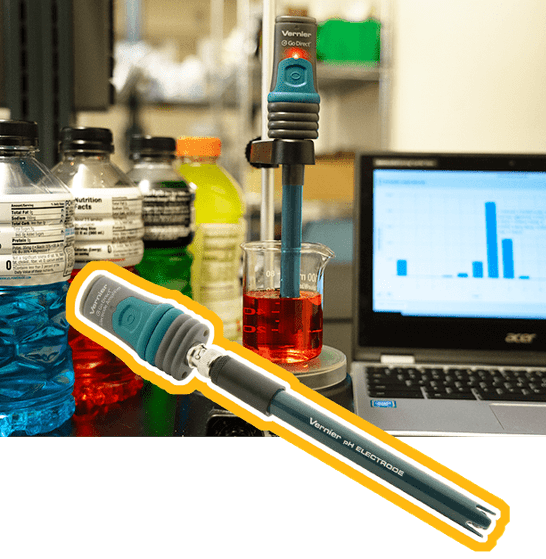
Explore pH without the inconvenience of wires, no more spilled solutions, or dangling wires.
The Go Direct pH Sensor is an important and versatile sensor for lab and field activities alike. It gives students the freedom to explore pH without the inconvenience of wires, spilled solutions, or dangling wires. Go Direct pH transmits live readings and captures data in real‑time.
Food chemistry investigations include
GDX-PH $119
On-Demand Resources for Food Chemistry
Check out our webinars and blog posts for more inspiration.
Blog Posts
We are scientists, educators, and your team.
As you implement data-collection technology into your teaching, we’re here to support you! Looking to learn more about our food products or have questions about ordering? Reach out to our team at chemistry@vernier.com.
“The more I can get my teachers to use Vernier, the happier they are.”
— Eric Scholz, Assistant Principal
Riverdale-Kingsbridge Academy, NY
Measure CO2 Levels in Beverages and Food Products
Monitor changes in carbon dioxide, temperature, and relative humidity easily with the Go Direct CO2 Sensor.
This sensor includes built-in temperature compensation and humidity protection. A 250 mL Nalgene bottle is included for running controlled experiments with small plants and animals.
Food Chemistry investigations include
GDX-CO2 $249


Visualize the Optical Rotation of Sugars, Amino Acids, and Proteins
Simple-to-use polarimeter and includes free downloadable experiments.
The Go Direct Polarimeter provides a visual representation of chirality by measuring the optical rotation of optical isomers such as sugars, amino acids, and proteins. This Polarimeter is simple to use, includes free, downloadable experiments, and is supported by the free Vernier Instrumental Analysis® app.
Its unique vertical layout and lack of custom glassware make this polarimeter very student friendly. In addition, the analyzer is automatically rotated by an internal motor giving students more time to understand experiments such as the reaction kinetics of HCl and sucrose.
Food chemistry investigations include
GDX-POL $559

Webinars
